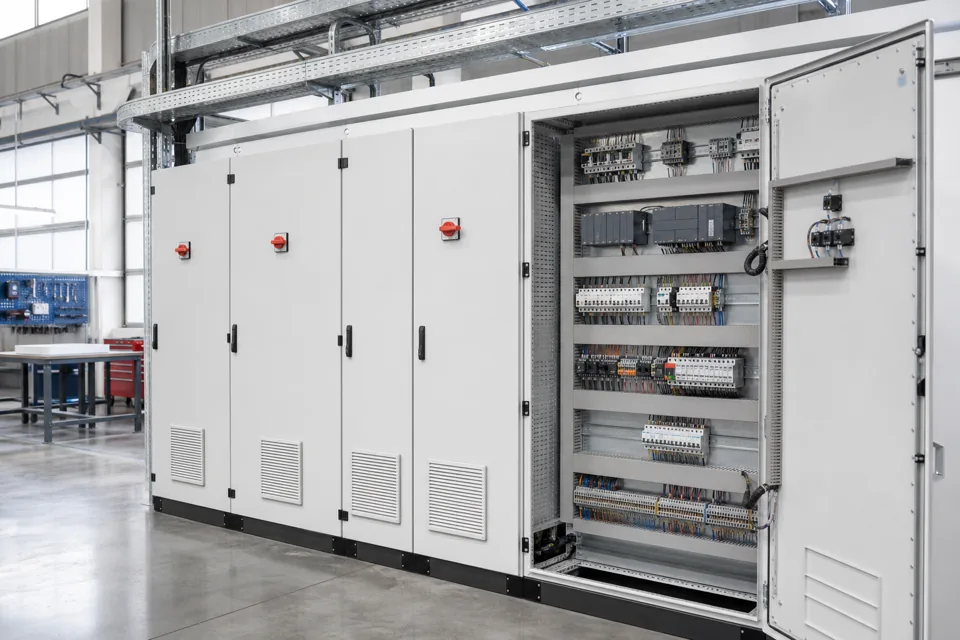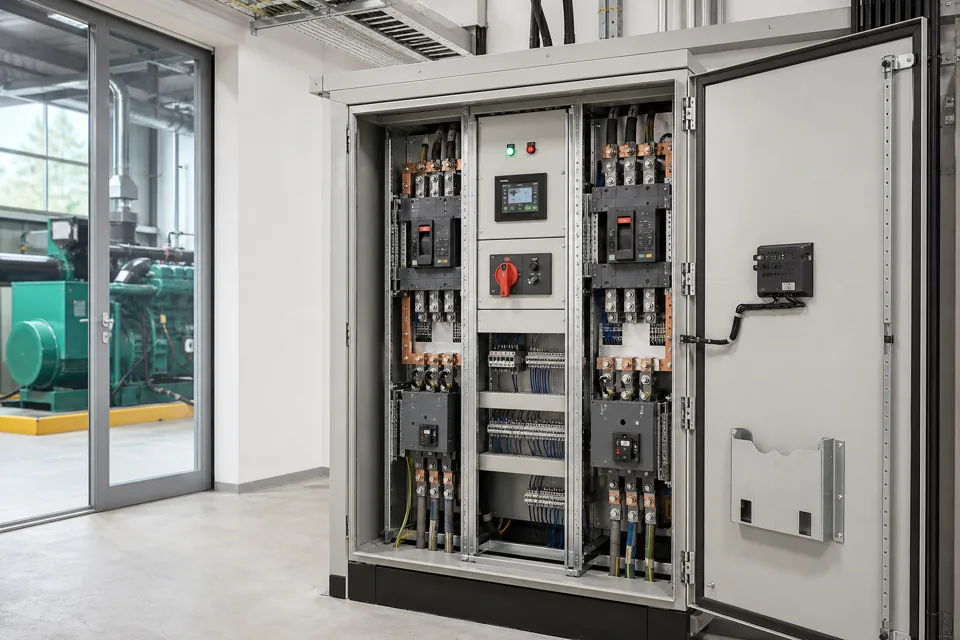

Brownfield documentation recovery creates a confidence-marked electrical record by comparing available drawings with safe field observations, device data and operating evidence before design changes begin.
- A neat redrawn SLD is not an as-built record until its facts and evidence status are controlled.
- Unknown and inaccessible circuits should stay visibly unresolved rather than inferred from adjacent equipment.
- Field verification must follow the site's electrical safety and isolation process.
Build a document and evidence source register
Every drawing, schedule, label, setting and field observation receives provenance before conflicting information is reconciled.
Start with a register containing title, revision, date, origin and status. A construction issue drawing, maintenance markup and operator sketch may all be useful, but they do not carry the same authority or scope.
Assign each recovered fact a source reference. When two sources conflict, keep both observations visible until a safe field check or authorised decision closes the discrepancy.
Evidence basis[1] International Electrotechnical Commission[2] Central Electricity Authority, Government of India
Build a document and evidence source register
Every drawing, schedule, label, setting and field observation receives provenance before conflicting information is reconciled.

Final ratings, protection, earthing, settings and interlocks follow approved project engineering.
Open full-size SVGPlan safe, bounded field verification
Observation scope, isolation state and prohibited actions are agreed before inspecting an energised or de-energised electrical installation.
Use the site's permit, isolation, access and PPE process. Decide which information can be obtained from external labels, which needs a scheduled shutdown, and which cannot be verified within the current scope. Do not open or trace live circuits merely to complete a drawing.
Capture panel identity, source and outgoing labels, protective devices, conductor markings, CT and VT data, cable destinations and obvious unused or modified circuits. Record the observation location and state so photographs and notes can be interpreted later.
Evidence basis[2] Central Electricity Authority, Government of India[3] International Electrotechnical Commission
Plan safe, bounded field verification
Observation scope, isolation state and prohibited actions are agreed before inspecting an energised or de-energised electrical installation.

Final ratings, protection, earthing, settings and interlocks follow approved project engineering.
Open full-size SVGRelease confidence-marked records and discrepancies
Verified, inferred and unresolved information must remain distinguishable when the recovered record enters design or maintenance use.
Use a legend for confidence status and preserve unresolved nodes on the SLD and schedules. Issue a discrepancy register with the consequence of each gap, the next safe evidence step and the owner authorised to close it.
Before a modification is engineered, freeze the recovered baseline revision and identify the facts that still constrain protection, fault level, interlocking, cable capacity or shutdown planning. The recovered pack supports the next decision; it does not certify conditions that were not observed.
Evidence basis[1] International Electrotechnical Commission[2] Central Electricity Authority, Government of India[3] International Electrotechnical Commission
| Status | Meaning | Allowed use |
|---|---|---|
| Verified | Observed or approved evidence agrees | Use within stated observation scope |
| Inferred | Derived from related evidence | Requires confirmation before critical design |
| Document-only | Not field checked | Reference with revision warning |
| Unresolved | Conflict or access gap remains | Do not assume in final engineering |
Information that makes the next review more useful.
- 01
Collect every available SLD, panel GA, schematic, cable schedule, load list, settings file and prior report.
- 02
Create a source register with document revision, date, origin and apparent authority.
- 03
Plan field access, isolation, permits, PPE and observation limits before opening equipment.
- 04
Assign stable identifiers to sources, buses, panels, feeders and significant loads.
- 05
Record nameplate, label, conductor and protection observations with location and time.
- 06
Mark each recovered fact as verified, inferred, document-only or unresolved.
- 07
Issue a discrepancy list and obtain approved closures before using the record for final design.
Standards and technical references.
Links identify the source and scope; access to a complete standard may require purchase or organisational access.
- 01IEC 61439-1:2020 — General rules for low-voltage assembliesInternational Electrotechnical Commission
- 02Central Electricity Authority safety and electric-supply regulations, 2023Central Electricity Authority, Government of India
- 03IEC 60204-1:2016 — Electrical equipment of machinesInternational Electrotechnical Commission
Questions engineers and project teams ask.
Can an old electrical drawing be treated as the as-built record?
Only after its scope and revision are checked against approved records and safe field evidence. Until then, keep it as one source with a stated confidence level.
How should an inaccessible feeder be shown on a recovered SLD?
Mark it as unresolved or document-only with the source and limitation. Do not copy a probable destination into the verified layer without evidence.